|
<< Click to Display Table of Contents >> Polarimetry and PolInSAR - Polarimetry - Entropy Alpha Anisotropy Classification |
  
|
|
<< Click to Display Table of Contents >> Polarimetry and PolInSAR - Polarimetry - Entropy Alpha Anisotropy Classification |
|
Purpose
An unsupervised classification, enabling to discriminate the main scattering types on the basis of the Entropy Alpha Anisotropy decomposition, is performed. The classification is generated in Slant Range geometry with the original pixel sampling; it can be directly geocoded using the "Basic module>Geocoding" functionality (the "Optimal Resolution" resampling method is suggested in order to avoid undesired pixel distortions).
Technical Note
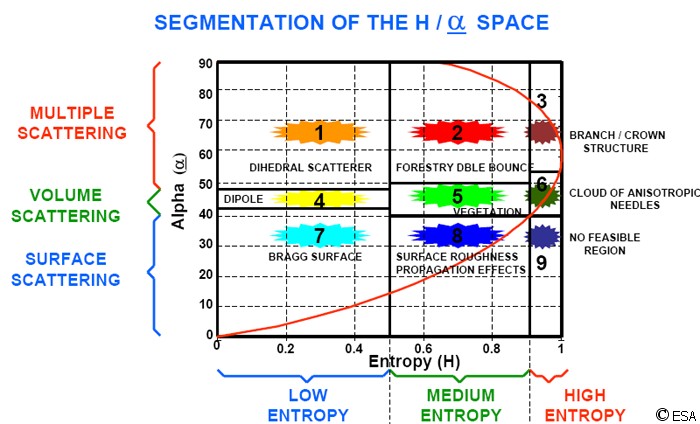
Cloude and Pottier proposed an algorithm to identify, in an unsupervised way, the polarimetric scattering mechanisms in the H-α (Entropy-Mean alpha angle) plane. The basic idea is that entropy arises as a natural measure of the inherent reversibility of the scattering data and that the mean alpha angle can be used to identify the underlying average scattering mechanism.
The H-α plane is divided in 9 basic zones characteristic of different scattering behaviours (see figure below). The basic scattering mechanism of each pixel can be identified by comparing its entropy and mean alpha angle parameters to fixed thresholds. The different class boundaries, in the H-α plane, have been determined in order to discriminate surface reflection, volume diffusion, and double bounce reflection along the α axis; while low, medium, and high degree of randomness are represented along the H axis. The red curve identifies the area in the alpha-Entropy plane where "physically possible" results can be obtained.
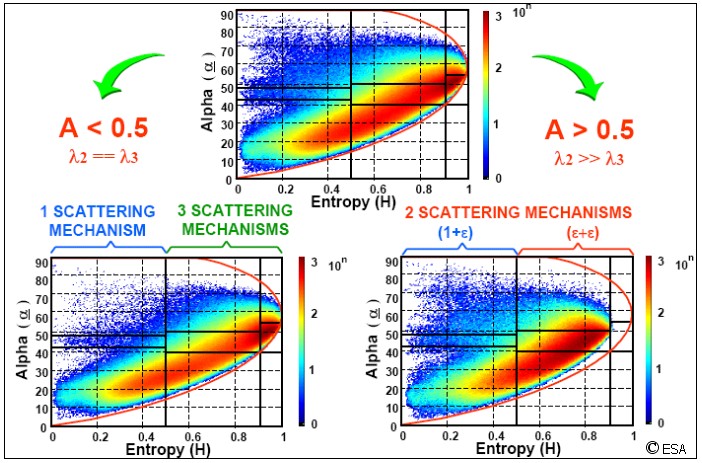
The proposed procedure may be further improved by explicitly including the anisotropy information (see figure below). This polarimetric indicator is particularly useful to discriminate scattering mechanisms with different eigenvalue distributions but with similar intermediate entropy values. In such cases, a high anisotropy value indicates two dominant scattering mechanisms with equal probability and a less significant third mechanism, while a low anisotropy value corresponds to a dominant first scattering mechanism and two non-negligible secondary mechanisms with equal importance.
Note: the Entropy-Anisotropy-Alpha classification is not available for dual pole data.
Input Files
Input file
Name of the input file including the Entropy-Anisotropy-Alpha decomposition (.list). This file is mandatory.
Output Files
Output file
Name of the output classification file. This file is mandatory.
Root Name
Classification with the associated header files (.sml, .hdr).
General Functions
Exec
The processing step is executed.
Store Batch
The processing step is stored in the batch list. The Batch Browser button allows to load the batch processing list.
Close
The window will be closed.
Help
Specific help document section.
Specific Function(s)
None.
Task, SARscapeBatch object, SARscapeBatch script example
References ESA, Polarimetric SAR Interferometry tutorial S. Cloude and E. Pottier: "An entropy based classification scheme for land applications of polarimetric SAR". Geoscience and Remote Sensing, IEEE Transactions on, vol. 35, no. 1, Jan. 1997, pp. 68 - 78.