|
<< Click to Display Table of Contents >> Interferometry - Clustered Processes - CCD Cluster |
  
|
|
<< Click to Display Table of Contents >> Interferometry - Clustered Processes - CCD Cluster |
|
Purpose
Single-date and multi-temporal features based on first order statistics Intensity image(s) or interferometric image pairs can be derived from SAR data. These features enable, depending upon the targeted product, to detect and extract structures or temporal changes, which can be additionally used for segmentation and/or classification purposes. This process will exploit the capabilities of SARscape cluster (if enabled and licensed). As a function of cluster nodes, the full area is splitted in more subareas and each subarea is processed. A mosaiced final result is obtained.
Technical Note
Given two coregistered complex SAR images (S1 and S2), one calculates the interferometric coherence (γ) as a ratio between coherent and incoherent summations. Note that the observed coherence - which ranges between 0 and 1 - is, in primis, a function of systemic spatial de-correlation, the additive noise, and the scene de-correlation that takes place between the two acquisitions.
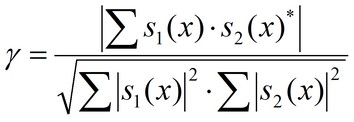
The estimated coherence - which ranges between 0 and 1 - is function of:
| - | Systemic spatial de-correlation (i.e. the additive noise). |
| - | Temporal de-correlation between Reference and Secondary acquisitions. |
The coherence product has essentially a twofold purpose:
| - | To determine the quality of the measurement (i.e. interferometric phase). As a rule of thumb, InSAR pairs with low coherence should not be used to derive reliable phase related measurements. |
| - | To extract thematic information relevant to the ground features properties and their temporal changes. This information is enhanced when coupled with the backscattering coefficient (σo) of the Reference and Secondary Intensity data. |
As a general rule it can be assumed that the coherence decreases with increasing Reference-Secondary acquisition time distance. The relationship between the coherence (γ) and the Signal to Noise Ratio (SNR) is:
SNR = γ2/1-γ2
In case the two images are very much different in terms of areal coverage, the smallest one should be used as "Input Reference file" in order to avoid the coregistration windows to be located in areas with null pixel values, which can eventually cause the coregistration process to fail. For details about the coregistration process, refer to the relevant Technical Note.
In case of baseline conditions - or topographic conditions - which cause the coherence to get lost due to the very fast change of the interferometric phase, it is suggested to over sample the range pixel size by entering negative values in the Range Multilooking (Preferences>Interferometry>Multilooking). As an example using ERS-ASAR interferometric tandem pairs, which are characterized by a very small ambiguity height (hence very dense/frequent interferometric fringes), the Interferometric multilooking factors shall be set to -2 and 3 (respectively in Range and Azimuth).
The use of the Digital Elevation Model in input (optional) enables to generate the coherence image using the interferogram flattened on the basis of the known topography.
In case of inaccuracy in the satellite orbits or in the Digital Elevation Model geolocation, a Ground Control Point (i.e. "GCP" file) is required to correct the SAR data (i.e. "Input Reference SLC" file) with respect to the reference Digital Elevation Model. In this case the shift calculated in the coregistration process is combined with the Ground Control Point shift in order to correct the data of the Input file list according to the Input reference file.
It is important to note that:
❖the Reference file should be the image characterized by the higher spatial resolution (as a consequence of the higher incidence angle)
❖In case the "Input Reference SLC file" has already been corrected with the manual or the automatic procedure the GCP is not needed.
❖In case the "Input Reference SLC file" is correct (i.e. the nominally geocoded image fits with the DEM), while the orbital parameters of the "Input Secondary SLC file" are not accurate (i.e. the nominally geocoded image does not fit with the DEM), the GCP is not needed but the flag "Automatic Secondary Orbit Correction", in the Preferences>Flattening, must be checked.
The coherence image can be generated from the input unfiltered interferogram or from the filtered one, using one of the available filtering methods. The selected option can be specified in the relevant Preferences.
Cluster:
The processing for the geocoded coherence map generation is divided among different machines: by splitting the input pair into smaller parts accordingly with the cluster node number in case of Stripmap data or sending the ScanSAR/TOPSAR bursts to the cluster nodes directly. Each node will perform the coregistration, the interferogram generation and flattening the coherence generation and the geocoding. The orchestrator will have the tasks to split the input data, join toghether the coregistration parameters of each patch, and assemble the geocoded parts coming from the nodes. The entire process is then parallelized with a small additional overhead for the orchestrator tasks.
Input Files
Input Reference file
Input file name of the (not coregistered) Single Look Complex (_slc) Reference data. This file is mandatory.
Input Secondary file
Input file name of the (not coregistered) Single Look Complex (_slc) Secondary data. This file is mandatory.
Optional Files
ScanSAR-TOPSAR Spectral Diversity Avoid Area
Spectral Diversity is used to improve the coregistration along the Azimuth direction of the ScanSAR-TOPSAR mode data. Without a perfect coregistration along the azimuth direction phase slopes will appear along the same direction. Issues may arise when the spectral diversity is calculated on areas that show phase slopes along the azimuth direction related to real and strong surface displacement event (e.g. earthquakes); in such circumstances the tool could interpretate the phase ramp as a consequence of a miss-coregistration. To avoid this behavior the user can draw the area where the spectral diversity should not be performed. The shapefile of the avoid area must be geocoded (lat-long). All the ScanSAR or TOPSAR bursts which intersect this shapefile will be avoided during the Spectral Diversity estimation step. This file is optional.
DEM/Cartographic System
Digital Elevation Model file
Digital Elevation Model file name. This should be referred to the ellipsoid. In case a list of input files is entered, the DEM must cover the whole imaged area. This file is optional.
Output Projection
In case that the Digital Elevation Model is not used, it is mandatory to define the Cartographic System.
To use the same coordinate system as another dataset, click the Import from Existing Dataset button and select the source dataset.
To apply the same Coordinate System of the current selected layer
The reset icon allows to reset the coordinate system field.
Parameters - Principal Parameters
Range looks
Number of looks in range.
Azimuth looks
Number of looks in azimuth.
Grid Size for Suggested Looks
The grid size, in meters, used to tune range and azimuth looks. If the other parameters are manually set, the grid size will not imply a change in their values.
X and Y Grid Size
The grid size of the output data must be defined; the default unit of measure is meters.
Coregistration with DEM
By setting this flag, the input Digital Elevation Model is used in the coregistration process.
Filtering method
The filtering methods can be selected:
•Boxcar
•Adaptive Non-Local
Coherence AZ Box Range
Window Size in Azimuth direction for Boxcar method.
Coherence RG Box Range
Window Size in Azimuth direction for Boxcar method.
Parameters - Cluster
It brings to the general section of the Preferences parameters. Any modified value will be used and stored for further processing sessions.
Parameters - Global
It brings to the general section of the Preferences parameters. Any modified value will be used and stored for further processing sessions.
Parameters - Interferogram
It brings to the Interferometry section of the Preferences parameters. Any modified value will be used and stored for further processing sessions.
Parameters - Flattening
It brings to the Flattening section of the Preferences parameters. Any modified value will be used and stored for further processing sessions.
Parameters - Filtering
It brings to the Adaptive Filtering section of the Preferences parameters. Any modified value will be used and stored for further processing sessions.
Parameters - Coregistration
It brings to the coregistration section of the Preferences parameters. Any modified value will be used and stored for further processing sessions.
Parameters - Other Parameters
It brings to the general section of the Preferences parameters. Any modified value will be used and stored for further processing sessions.
Output Files
Output Root Name
Name of the output root. This file is mandatory.
_cc
Coherence and associated header files (.sml, .hdr).
Details specific to the Units of Measure and Nomenclature of the output products can be found in the Data Format section.
General Functions
Exec
The processing step is executed.
Store Batch
The processing step is stored in the batch list. The Batch Browser button allows to load the batch processing list.
Close
The window will be closed.
Help
Specific help document section.
Specific Function(s)
None.
Task, SARscapeBatch object, SARscapeBatch script example
References Gatelli F., A. Monti Guarnieri, F. Parizzi, P. Pasquali, C. Prati, F. Rocca, The Wavenumber Shift in SAR Interferometry, IEEE Transactions on Geoscience and Remote Sensing, Vol. 32, No. 4, 1994. Stebler O., P. Pasquali, D. Small, F. Holecz, and D. Nuesch, Analysis of ERS-SAR tandem time-series using coherence and backscattering coefficient, , Proceedings of Fringe '96 workshop, ESA SP-406, 1997.