AgCalculateAndRasterizeCropMetrics Task
This task calculates statistics from a single-band raster and an associated ENVIAgCrops object. It creates a classification raster showing the relative means of crops or a grayscale raster showing actual mean values of crops. For example, if the input raster is a vegetation index such as NDVI, the crop means describe the health of the crops.
AgCalculateAndRasterizeCropMetrics is a metatask that automatically runs the following tasks:
You can run AgCropCountTask or AgCountAndRasterizeCropsTask to create the ENVIAgCrops object that is required for this task. Or, you can use an ENVIAgCrops file that you created and saved earlier.
This task requires a separate license for the ENVI Crop Science Module; contact your sales representative for more information.
Example
This example performs the following steps.
- Opens an orthophoto of a citrus orchard.
- Creates a spectral index raster to make the citrus trees bright against the background. A Normalized Difference Vegetation Index (NDVI) works well in this case. NDVI will be used for crop counting and for calculating metrics in this example.
- Runs ENVIAgCropCount to count the trees and to create an ENVIAgCrops object.
- Runs AgCalculateAndRasterizeCropMetrics task, using the NDVI image as the basis for calculating metrics.
- Displays a classification raster showing relative NDVI means of the citrus trees.
- Prints the range of crop NDVI values in the entire image.
Tip: See SpectralIndex Task for a list of spectral indices. You can run QuerySpectralIndices Task to see what indices are available for your particular image.
; Start the application
e = ENVI()
; Open an input file
File = Filepath('CitrusOrthophoto.dat', $
Subdir=['data','crop_science'], $
Root_Dir=e.Root_Dir)
Raster = e.OpenRaster(File)
; Preprocess the image so that crops are bright.
NDVIImage = ENVISpectralIndexRaster(Raster, 'NDVI')
; Count the crops and output an ENVIAgCrops object
outCrops = ENVIAgCropCount(NDVIImage, 2.0, 5.0, $
GAUSSIAN_FACTOR = 0, $
/INCLUDE_EDGES, $
INTENSITY_THRESHOLD = 0.8, $
NUMBER_OF_INCREMENTS = 4, $
PERCENT_OVERLAP = 100.0)
; Get the metrics task from the catalog of ENVITasks
Task = ENVITask('AgCalculateAndRasterizeCropMetrics')
; Define inputs
Task.INPUT_CROPS = outCrops
Task.INPUT_RASTER = NDVIImage
; Run the task
Task.Execute
; Get the collection of objects currently in the Data Manager
DataColl = e.Data
; Add the output to the data collection
DataColl.Add, Task.OUTPUT_RASTER
; Display the result
View = e.GetView()
Layer = View.CreateLayer(Task.OUTPUT_RASTER)
View.Zoom, /FULL_EXTENT
; Print the range of NDVI values
crops = Task.OUTPUT_CROPS
Print, 'Minimum NDVI value for entire image: ',MIN(crops.CROP_MIN)
Print, 'Maximum NDVI value for entire image: ',MAX(crops.CROP_MAX)
Syntax
Result = ENVITask('AgCalculateAndRasterizeCropMetrics')
Input parameters (Set, Get): CLASSIFICATION, INPUT_CROPS, INPUT_RASTER, OUTPUT_CROPS_URI, OUTPUT_METRIC, OUTPUT_RASTER_URI
Output parameters (Get only): OUTPUT_CROPS, OUTPUT_RASTER
Parameters marked as "Set" are those that you can set to specific values. You can also retrieve their current values any time. Parameters marked as "Get" are those whose values you can retrieve but not set.
Input Parameters
CLASSIFICATION (optional)
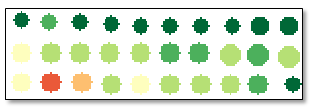
Set this parameter to true (the default value) to create a classification raster where crops are colored according to relative means. For example, a dark green polygon corresponds to a crop with a higher mean value than light-green, yellow, and red polygons. The resulting raster will look similar to the following:
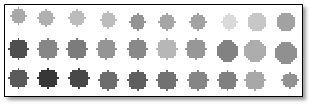
If set to false, the output will be a grayscale raster that is based on the actual mean values of the crops; for example:
INPUT_CROPS (required)
Specify an input ENVIAgCrops object. You can run AgCropCount Task or AgCountAndRasterizeCrops Task to create an ENVIAgCrops object before running this task. Or, you can use an ENVIAgCrops file that you created and saved earlier.
INPUT_RASTER (required)
Specify a single-band raster from which crop metrics will be computed. A common example is a spectral index raster such as Normalized Difference Vegetation Index (NDVI).
OUTPUT_CROPS_URI (optional)
Specify a string with the fully qualified filename and path for the output JSON file that will contain the crop data.
OUTPUT_METRIC (optional)
Set this parameter to one of the following strings, indicating the metric that the output raster will be based on:
Crop Mean(default)Crop MaximumCrop MinimumCrop Standard DeviationRadius
OUTPUT_RASTER_URI (optional)
Specify a string with the fully qualified filename and path of the associated OUTPUT_RASTER.
- If you do not specify this parameter, or set it to an exclamation symbol (!), ENVI creates a temporary file.
- If you set it to the hash symbol (#), ENVI creates a file in the temporary directory, but this file will not be deleted when ENVI closes.
Output Parameters
OUTPUT_CROPS
This is a reference to the output crop data.
OUTPUT_RASTER
This is a reference to the output crops classification raster or grayscale raster.
Methods
Properties
Version History
|
Crop Science 1.0 |
Introduced |
|
Crop Science 1.1 |
Added Crop Minimum, Crop Maximum, Crop Standard Deviation, and Radius options to OUTPUT_METRIC. |
See Also
AgCalculateCropMetrics Task, AgCalculateAndRasterizeCropMetricsWithSpectralIndex Task, ENVIAgCrops, AgCropCount Task, AgCountAndRasterizeCrops Task