What's New in ENVI Deep Learning 3.0
This release includes the following new and improved features.
Highlights
- New Grid Models
- Pixel Segmentation changes
- Updated Routines
- Updated Train TensorFlow Model Dialogs
- New task and tool in Machine Learning
New Grid Models
This release includes the ability to train TensorBoard Grid models. Grid is a binary classifier (0 or 1), where 0 evaluates to zero detections of any trained class and 1 evaluates to one or more classes detected in a cell. It is a standalone approach for tipping and queuing, to quickly identify potential features of interest. The Grid architecture is based on residual networks RestNet50 and ResNet101. ResNet50 is a smaller 50-layer architecture that is useful with minimal datasets; ResNet101 is a larger 101-layer architecture that provides better performance with large datasets. Its models support existing ENVI Deep Learning Raster formats, and one or more classes.
Additional benefits of using Grid include:
- It reduces false positives, to simplify manual efforts to correct deep learning results.
- Speed, which saves processing time and cost for cloud-based processing.
- It provides improved throughput of hardware-limited applications that cannot automatically scale to meet processing demands.
- You can quickly use more complex models and architectures that can better detect unique features, such as the new TensorFlow Optimized Object Classification and TensorFlow Optimized Pixel Classification.
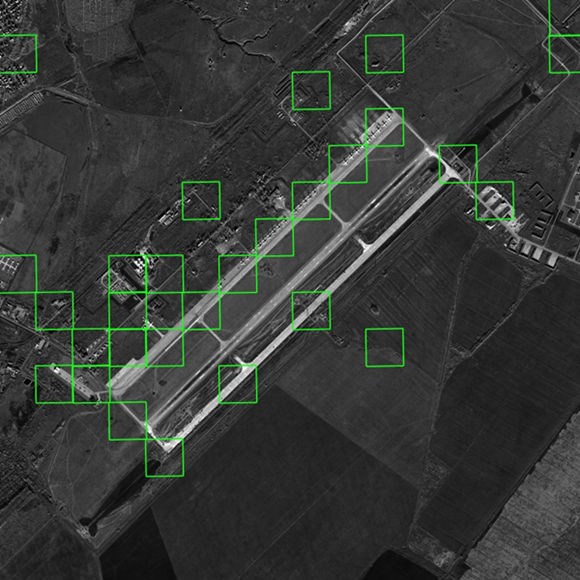
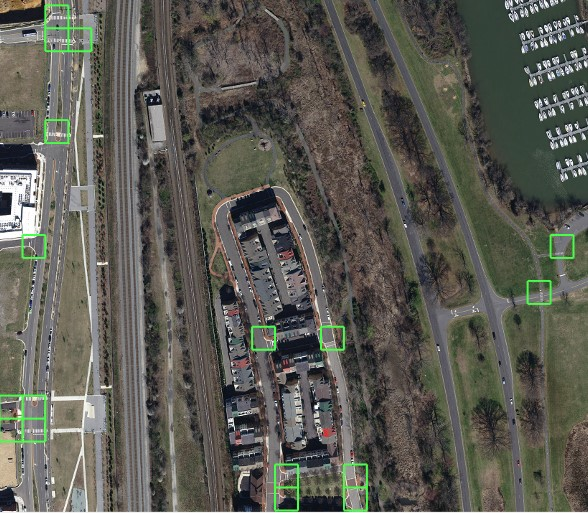
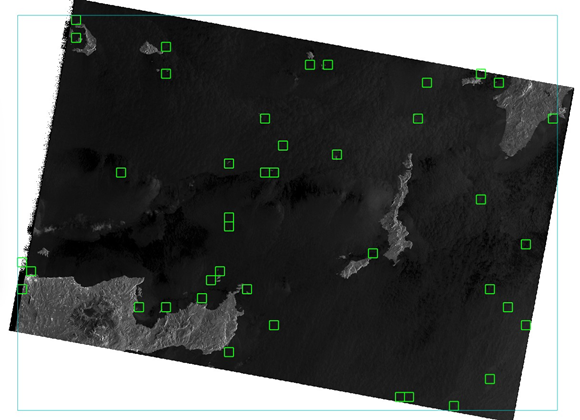
The following are examples of using Grid.
Detecting potential locations of aircraft in WorldView panchromatic imagery:
A quick cloud mask using WorldView RGB data:

Mapping locations of crosswalks using grids and high-resolution aerial imagery over Washington DC (courtesy of the DC Open Data program):
Quickly find areas where potential ships are in Sentinel 1 SAR data:
These new tasks and ENVI Toolbox tools have been added for Grid:
- TrainTensorFlowGridModel Task and Train TensorFlow Grid Models tool: Trains a TensorFlow Grid model to locate regions containing targets of interest.
- TensorFlowGridClassification Task and TensorFlow Grid Classification tool: Classifies a raster using a trained TensorFlow grid model. The output is a shapefile of bounding boxes for each class. Performs inference on a raster using a trained TensorFlow grid model.
- TensorFlowOptimizedObjectClassification Task and TensorFlow Optimized Object Classification tool: Uses a trained TensorFlow grid model and a trained TensorFlow object detection model to perform inference on a raster in regions that contain features of interest identified by a grid model. The output is an object shapefile of bounding boxes for each class, and a grid shapefile of areas containing objects detected.
- TensorFlowOptimizedPixelClassification Task and TensorFlow Optimized Pixel Classification tool: Uses a trained TensorFlow grid model and a trained TensorFlow pixel segmentation model to perform inference on a raster in regions that contain features of interest identified by a grid model. The result is a classification image and a grid output vector. Optional output is a class activation raster whose pixel values represent the probability (0 to 1) of matching the feature of interest.
The following routine has been added for Grid:
- ENVITensorFlowGridModel: This function restores an ENVITensorFlowGridModel object, which specifies the TensorFlow model used for deep learning.
Pixel Segmentation Changes
This release includes changes to the Pixel Segmentation workflows to improve the user experience by saving time and improving results. These are breaking changes to API and ENVI Modeler models that were created using ENVI Deep Learning version 2.1 or older. See ENVI Deep Learning 3.0 Migration Guide for instructions on how to convert these older models to ENVI Deep Learning 3.0.
Renamed tasks:
- RandomizeTrainTensorFlowMaskModel has been renamed to RandomizeTrainTensorFlowPixelModel
- TensorFlowMaskClassification has been renamed to TensorFlowPixelClassification
- TrainTensorFlowMaskModel has been renamed to TrainTensorFlowPixelModel
Deprecated task/Toolbox tool:
- InitializeENVINet5MultiModel task and Initialize Pixel Segmentation Model dialog have been deprecated. This task is no longer needed when training a pixel model. Initialization has been incorporated into TrainTensorFlowPixelModel.
New parameters added to the TrainTensorFlowPixelModel task/TensorFlow Pixel Classification Toolbox tool:
- Feature Patch Percentage: Specify the percentage of patches that contain labeled features to use during training.
- Background Patch Ratio: Specify the ratio of background patches (those that contain no labeled features) to patches with features.
- Trained Model: Provide a trained pixel model to use as a starting point.
TrainTensorFlowPixelModel task/TensorFlow Pixel Classification dialog parameters that are obsolete as of this release:
- Input Model
- Number of Bands
- Number of Classes
- Patches per Epoch
- Patch Sampling Rate
Updated Routines
The METRICS property has been added to the following routines:
- ENVITensorFlowModel
- ENVITensorFlowObjectModel
The METRICS property is a Hash of model training and validation metrics produced by TensorFlow which provides an estimation of the performance of the trained TensorFlow model.
Updated Train TensorFlow Model Dialogs
ENVI Deep Learning training dialogs (Train TensorFlow Pixel Model, Train TensorFlow Object Model, and the new Train TensorFlow Grid Model) now use tabs to organize the available parameters.
Below is an example of the changes using the Train TensorFlow Pixel Model dialog:
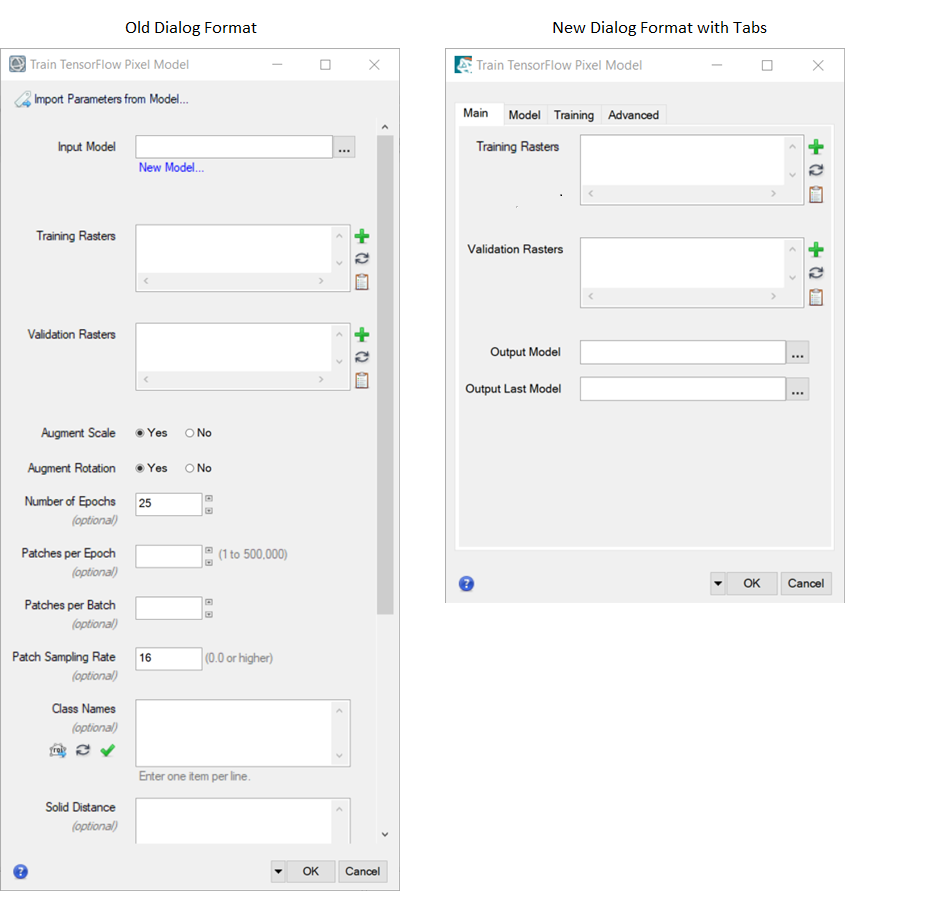
Each dialog has the following four tabs:
- Main: The Main tab provides the minimal set of parameters that must be used for model training. The remaining parameters in the dialog can be modified, or they can use their default settings.
- Model: The Model tab has parameters for the Model Name and Model Description, plus additional parameters that are specific to the model that will be trained.
- Training: The Training tab provides tuning parameters that control the amount of data regarding foreground, background, augmentation, and the duration of training.
- Advanced: The Advanced tab contains parameters for data manipulation during the training process.
For additional details on the parameters available fortraining each model type, see the documentation for Train TensorFlow Object Models, Train TensorFlow Pixel Models, and Train TensorFlow Grid Models.
New Task and Tool in Machine Learning
- MachineLearningEvaluateClassifier Task
- Machine Learning Evaluate Classifier Tool
The new task and tool evaluates a classifier using labeled rasters that may or may not have been used during training. It generates a report containing statistics about the classifiers performance against the input rasters, and provides a confusion matrix of all classes as part of the report. These topics are located under ENVI Machine Learning in ENVI Help.