|
<< Click to Display Table of Contents >> Preferences specific - Modeling |
  
|
|
<< Click to Display Table of Contents >> Preferences specific - Modeling |
|
Purpose
This panel enables to set the default processing parameters, which are used in those functions related only to the Interferometry Modeling functionalities.
Technical Note
The GENERIC PARAMETERS section contains parameters related to the statistical properties of InSAR dataset. They describe the spatial autocorrelation, which is assumed to exponentially decay according to
C(d) = C0·e-d/k [1]
where d is the distance between two points in the unwrapped map, C0 is the covariance at zero distance and k is a coefficient describing the covariance decrease with distance. We remark that the covariance at zero distance is not the data variance, which is higher. Default values for X, C and L bands, derived from empiric semi-variograms, are provided.
The NON-LINEAR PARAMETERS section allows the parameter setup of the Non-Linear Inversion algorithm; the algorithm is based on the Levemberg-Marquardt procedure [Marquardt, 1963], which is a mix of Gauss-Newton algorithm and the gradient descent method. The algorithm is implemented with multiple restarts starting from random configurations to get the global minimum of the cost function.
The cost function is a weighted mean of the χ-square value of every inverted dataset, according to
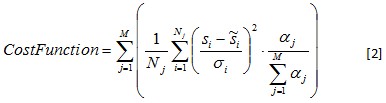
where M is the number of datasets, j is the dataset index, i is the index of a single measurement in the jth dataset, αj is the weight of the jth dataset, Nj is the number of measurements in the jth dataset, si, ŝj and σi are the observed and predicted displacement and the standard deviation of the ith measurement, respectively.
The computation length depends also on the data quality; when the displacement pattern is clear and the signal is strong, the cost function has a well-shaped global minimum and the algorithm is more effective. Parameter uncertainty and trade-offs can also be obtained: they are calculated perturbing, several times, data with a correlated noise (based on the GENERIC PARAMETERS values) and performing a new inversions.
The LINEAR PARAMETERS section allows the parameter setup of the Linear Inversion algorithm (see Menke [1989] for a complete review of the inversion techniques). The most important is the damping factor, applied to the parameter Laplacian operator, which affect the smoothness of the solution: the higher is the damping, the more smoothed is the solution. Although a default value is provided, it is strongly problem-dependent and ad hoc values must be considered. In tectonic modeling, it is possible to specify a different damping value for every source, from the source setting panel.
Parameters - Modeling
Non Linear Inversion: Test for global minimum
Number of times that the algorithm must find the same minimum in the cost function to keep it as global minimum. A default value of 3, in general, is enough to get good results.
Non Linear Inversion: Selected the report format
An already formatted report is provided in the selected format: HTML, PDF or Microsoft Office Document (.doc).
Non Linear Inversion: Cost function Tolerance
During the algorithm iterations, two consecutive configurations are considered equivalent when their cost function difference is below the tolerance. The default value is 0.0001.
Non Linear Inversion: Maximum Lev-Marq. iterations
Maximum number of algorithm restarts; this constraint plays a role only when data have a poor quality and the cost function global minimum is blurred among local minima. A default value of 300 is supplied.
Non Linear Inversion: Output Shapefiles for Sources
Set this flag to generate, for every source, a vector shapefile with the source parameters.
Non Linear Inversion: Output Shapefiles for Datasets
Set this flag to generate, for every dataset, a point shapefile.
Non Linear Inversion: Compute standard deviation and trade-offs
By setting this flag, standard deviations and trade-offs between parameters are also calculated .
Non Linear Inversion: Maximum iterations
Number of inversion to perform to calculate the scatter plot of the parameter standard deviations and trade-offs. Standard value is 50, but it can be significantly increased to get a denser scatter plot.
Non Linear Inversion: Statistic file name
Name of the file where the results of the Standard deviation and trade-off computation are stored.
Linear Inversion: Output Shapefiles for Sources
Set this flag to generate, for every source, a vector shapefile with the source parameters.
Linear Inversion: Output Shapefiles for Datasets
Set this flag to generate, for every dataset, a point shapefile.
Linear Inversion: Selected the report format
An already formatted report is provided in the selected format: HTML, PDF or Microsoft Office Document (.doc).
Linear Inversion: Default dumping factor
This factor affect the solution smoothing. Although a 0.05 default value is provided, it is strongly problem-dependent and ad hoc values must be considered.
Linear Inversion: Inversion algorithm
One of the following two can be selected:
- Non-Negative Least Squares: parameters are not allowed to assume negative values
- Unconstrained: parameters can assume negative values
Seismic Moment: value of the source seismic moment (not used in the inversion).
X-/C-/L-band Data variance
Variance of the data, in m2.
X-/C-/L-band Value at zero (this parameter is currently not used)
Covariance value at zero distance, C0 in the equation in Technical Note, in m2.
X-/C-/L-band Decreasing coefficient (this parameter is currently not used)
Coefficient describing how fast covariance decreases with distance, in m. Higher values correspond to a faster decay of the spatial correlation.
Lamé's first parameter λ, in Pa or N/m2. Default values are 30·109 Pa.
Lame's coefficient Mu
Lamé's second parameter μ or shear modulus, in Pa or N/m2. Default values are 30·109 Pa.
Default Output Directory
The default directory in which all the chosen outputs will be generated.
General Functions
Load Preferences
It allows loading specific Preferences tthirteen different settings as possible alternative default processing values.
Load
It allows loading an .xml, .sml or .txt file where SARscape common Preferences where previously saved.
Save
It allows saving SARscape common Preferences for a future processing using the same preferences characteristics.
Help
Specific help document section.
Ok
The selected default processing parameters are loaded.
Cancel
The window will be closed.
Specific Function(s)
None.
References
Marquardt, D. (1963), An algorithm for least-squares estimation of nonlinear parameters, SIAM J. Appl. Math., 11, 431 – 441, doi:10.1137/
0111030.
Menke, W. (1989), Geophysical Data Analysis: Discrete Inverse Theory, Academic Press, Inc., San Diego (California)